Stock vs Custom Logo: OCTOPUS Shoe Washing Bag MOQ Decision
Buyer guide for importers, distributors and private-label teams
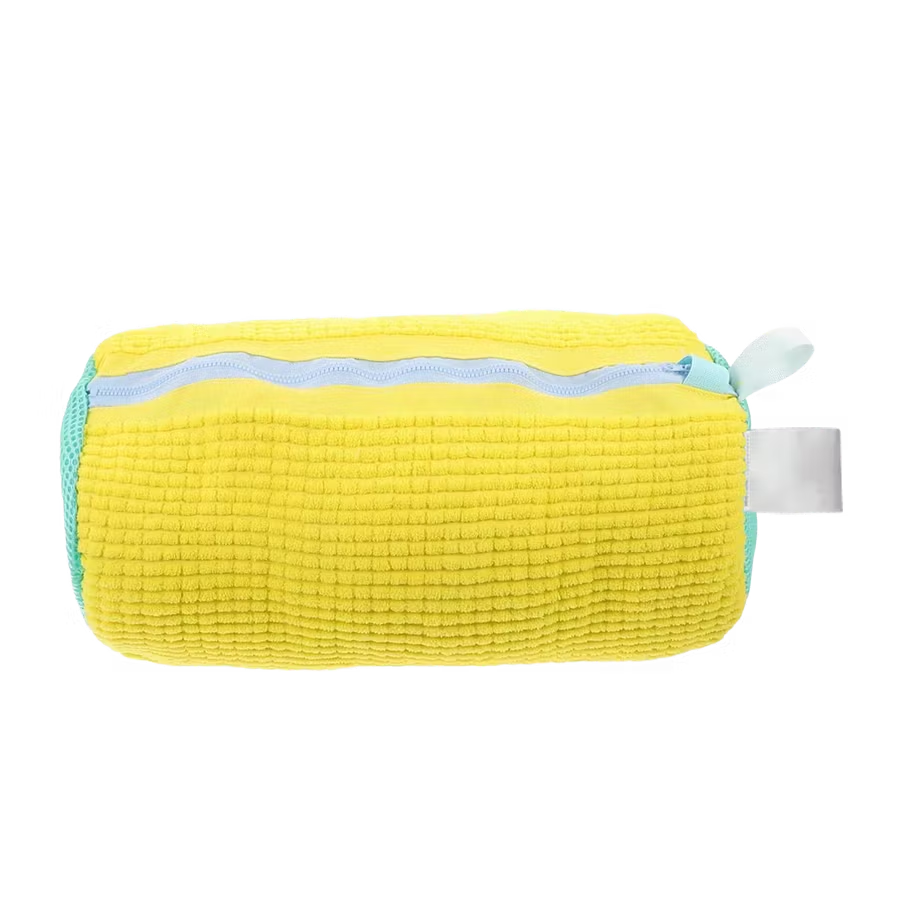
For the OCTOPUS Shoe Washing Bag, the stock-versus-custom-logo decision is mainly an order-volume decision. Stock orders start from 100 pieces. Logo customization starts from 500 pieces. Custom material is a separate escalation at 6,000 pieces. Choose stock when you need the standard two-bag set, a low commitment and a fast standard sample. Choose custom logo when you can commit 500 pieces and need brand marking on the product. Treat the 6,000-piece custom-material threshold as a different project, not as part of the logo decision.
OCTOPUS is the shoe-care brand of Zhejiang Runjiang New Material Technology Co., Ltd., with the Shoe Washing Bag as its core product promoted through www.octopusbag.com. The brand’s reference product for this comparison is OCTOPUS The 2-Pack, a chenille-lined mesh shoe washing bag with a locking clasp zipper.
The short answer
Use a stock order if the first requirement is speed, standard product and lower inventory exposure. Use a custom logo order if the product must carry your brand and you can meet the 500-piece logo MOQ. Do not move to the 6,000-piece custom-material tier unless the material change itself is necessary. A custom logo request does not automatically mean custom material, and it does not automatically mean custom packaging.
Why this MOQ decision matters
The buyer’s real problem is not whether a logo looks better. It is whether order volume, cash exposure, launch timing and brand control justify moving from a stock SKU to a 500-piece logo run. A stock order reduces the number of approvals and keeps the first purchase smaller. A custom logo order adds brand control, but it also adds artwork approval, a custom sample lead time and a larger commitment. A custom-material order adds another layer: new material validation and a much higher MOQ.
In textile accessories, MOQ tiers commonly separate stock products, logo changes and material changes because each change adds planning, sampling and inspection steps. The exact thresholds are supplier-specific. For this product, the supplied tiers are 100 pieces for stock, 500 pieces for logo customization and 6,000 pieces for custom material. Those three numbers should be kept separate in the buyer’s decision.
What the buyer is ordering
The OCTOPUS The 2-Pack is supplied as two separate shoe washing bags. Each bag measures 30 x 25 cm and weighs approximately 200 g; the two-bag set weighs approximately 400 g. The construction uses a mesh exterior with a soft chenille lining. The closure is a zipper with a metal hook and anchor-loop locking clasp. A center pocket is provided for removable insoles and shoelaces.
The product is intended for household laundry and footwear care and for retail, e-commerce and wholesale shoe-care channels. Each bag is designed to hold one pair of compatible shoes, subject to actual shoe dimensions and care instructions. Use the bag only with footwear whose care label permits machine washing. Cold-water washing and air drying are recommended; do not bleach or tumble dry the bag.
Variant codes XYF-004-Y, XYF-004-YG and XYF-004-YW are existing color-option variants within the OCTOPUS The 2-Pack family. They are not separate structural designs. For this article, they matter only because the buyer should confirm the exact stock variant and the exact logo placement before comparing quotations.
The three MOQ tiers explained
Stock order: from 100 pieces. This is the lowest commitment tier. It fits a market test, a standard retail supply request or a buyer who does not need a logo. The product remains the standard OCTOPUS The 2-Pack, packed as two bags per set in bubble-bag packaging. The standard sample lead time is approximately 3 working days.
Custom logo order: from 500 pieces. This tier is for buyers who need logo customization on the product. The 500-piece figure is the logo MOQ, not the custom-material MOQ. Logo customization can be discussed together with size, material, color, zipper and packaging under OEM, ODM and private-label projects, but the exact scope must be agreed. Custom samples take approximately 15 working days, subject to the agreed design.
Custom material order: from 6,000 pieces. This is a separate escalation. It applies when the buyer needs a material change, not merely a logo. The 6,000-piece threshold should be treated as its own project with its own sample, validation and acceptance plan. A 500-piece logo order does not authorize a custom material, and a custom material request should not be priced or scheduled as if it were a standard logo run.
The supplied terms use the word “pieces.” Confirm whether one piece means one bag or one two-bag set before you convert the MOQ into cartons, retail units or inventory value. That single definition can change the commercial size of the order.
Stock vs custom logo: head-to-head comparison
| Decision factor | Stock OCTOPUS The 2-Pack | Custom logo order |
|---|---|---|
| Minimum order | 100 pieces | 500 pieces for logo customization |
| Custom material | Not part of the stock order | Separate 6,000-piece threshold |
| Product identity | Standard two-bag set; existing color-option variants | Same product family; logo customization discussed |
| Packaging | Two bags per set in bubble-bag packaging | Custom packaging by agreement |
| Sample lead time | Standard samples about 3 working days | Custom samples about 15 working days, subject to agreed design |
| Payment terms | Samples 100% T/T; bulk 30% deposit and 70% balance | Same stated terms |
| Acceptance | Agreed specifications; AQL 2.5; SGS, BV and TUV accepted as agreed | Agreed specifications; AQL 2.5; SGS, BV and TUV accepted as agreed |
| Typical buyer situation | Market test, fast launch, lower inventory, standard retail supply | Brand-led retail, private label, repeat program with logo control |
When stock is the better operational fit
Stock is the better fit when the buyer needs a standard product without logo differentiation and wants to keep the first order small. The 100-piece starting point supports a market test, a sample run for a retail account or a low-risk first purchase. The standard sample lead time of approximately 3 working days also supports buyers who need to check the product quickly before committing to a larger program.
- You need the standard two-bag set and do not need a logo on the product.
- You want to test a retail or e-commerce listing before committing to 500 pieces.
- You prefer standard bubble-bag packaging with two bags per set.
- You want to keep inventory exposure low while confirming sell-through.
- You need a fast standard sample rather than a custom sample cycle.
The limitation is clear: a stock order does not create logo differentiation. If the product must carry a private label or a brand mark, stock is a testing step, not the final brand program.
When custom logo is the better operational fit
Custom logo is the better fit when the product itself must carry the buyer’s brand and the buyer can commit to 500 pieces. This tier supports private-label and brand-led programs without automatically moving the order into custom material. The buyer should still confirm logo placement, artwork approval, sample timing and packaging scope before production.
- You can commit to 500 pieces for logo customization.
- You need brand marking on the product, not only on the packaging.
- You can allow approximately 15 working days for a custom sample, subject to the agreed design.
- You accept that custom packaging is a separate item agreed by contract.
- You have a repeat program or a retail channel that justifies the higher commitment.
The limitation is equally clear: a custom logo order is not a custom-material order. It does not automatically change the mesh, chenille lining, dimensions or construction. If the buyer needs a new material, the 6,000-piece threshold becomes the relevant tier.
The 6,000-piece custom-material threshold
The 6,000-piece custom-material threshold is not a larger logo MOQ. It is a separate escalation for buyers who need a material change. That distinction matters because a material change affects sampling, material sourcing, production planning and acceptance criteria. The buyer should not ask for a custom material under a 500-piece logo quotation and assume the same schedule or terms.
Move to the custom-material tier only when the material change is central to the product requirement. If the buyer only needs a logo, the 500-piece logo tier is the relevant decision. If the buyer needs a different material, the project should be planned around 6,000 pieces, with a custom sample, an agreed specification and an inspection plan before bulk production.
Packaging, payment and acceptance terms
Packaging. The standard supply is two bags per set in bubble-bag packaging. Custom packaging is available by agreement. A custom logo order should not be assumed to include custom packaging unless the packaging change is written into the quotation. Buyers should confirm the set configuration, the bag count per set, the packaging material and the artwork approval step.
Payment. The stated terms are 100% T/T for samples and 30% deposit with 70% balance for bulk. These terms affect the stock-versus-custom decision because a 500-piece logo order requires more cash than a 100-piece stock order, even before any custom packaging or custom material is added. The buyer should confirm the payment schedule, the deposit amount and the balance trigger in the quotation.
Acceptance. Acceptance is based on agreed specifications and AQL 2.5, with SGS, BV and TUV accepted as agreed. AQL 2.5 is an acceptance sampling level; it does not mean zero defects. The buyer and supplier should define the inspection scope, defect classes, sample size and acceptance criteria in the agreed specification. Third-party inspection by SGS, BV or TUV should be arranged only where it is accepted in the agreement.
The company holds ISO 9001:2015 certification covering production of nonwoven fabrics and industrial textile products, including storage boxes and cooler bags. That scope is not a product certification for shoe washing bags. For this order, the product specification and the agreed inspection terms remain the relevant acceptance basis.
Step-by-step decision path
- Confirm the exact SKU. Define whether the order is for the standard OCTOPUS The 2-Pack, a specific existing color-option variant or a logo version. Confirm the model and variant before comparing MOQs.
- Define what a piece means. Ask whether 100, 500 and 6,000 pieces refer to single bags or two-bag sets. Convert the figure into sets and cartons before you calculate inventory value.
- Map the first order to one tier. Use 100 pieces for stock, 500 pieces for logo customization and 6,000 pieces only for custom material. Do not mix the tiers in one approval.
- Request the right sample. Use the standard sample route of approximately 3 working days for a stock check. Use the custom sample route of approximately 15 working days, subject to the agreed design, for a logo project.
- Lock packaging and artwork. Confirm standard two-bags-per-set bubble-bag packaging or a custom packaging specification by agreement. Approve the logo artwork and placement before bulk production.
- Agree payment and inspection. Confirm the 100% T/T sample payment, the 30% deposit and 70% balance for bulk, and the AQL 2.5 acceptance terms. Name any agreed third-party inspection provider.
- Scale after acceptance. Use the stock order to test the market, then move to the 500-piece logo tier when brand control is needed. Move to 6,000 pieces only when a material change is confirmed.
Use cases by buyer type
Household and small retail test. A 100-piece stock order fits a first market test, a small retail supply request or a buyer who needs the standard product quickly. The buyer can check the two-bag set, the chenille lining and the locking clasp zipper before committing to a logo program.
E-commerce private label. A 500-piece custom logo order fits a private-label listing where the product needs brand marking. The buyer should plan for a custom sample, artwork approval and a longer sample cycle. If the product also needs custom packaging, that should be quoted separately by agreement.
Wholesale distributor. A distributor serving several retail accounts may keep the standard two-bag set in stock and reserve the 500-piece logo tier for accounts that can support the higher commitment. This separates standard supply from brand-specific inventory.
Brand material program. A buyer who needs a different material should plan around the 6,000-piece custom-material threshold. This is a separate project with its own sample, validation and acceptance plan. It should not be treated as a logo-only order.
The same decision framework can be applied to a large shoe washing bag, travel shoe washing bag or another reusable shoe washing bag format, but the MOQ must be confirmed for that exact item. Do not assume the 100, 500 and 6,000-piece tiers transfer to every construction without written confirmation.
Risks and limitations to check before ordering
- MOQ definition risk. A piece may mean a single bag or a two-bag set. Confirm the definition in the quotation.
- Inventory risk. A 500-piece logo order carries more stock than a 100-piece stock order. The buyer should match the order to a realistic sales plan.
- Artwork risk. Logo placement, size and approval steps should be confirmed before the custom sample is made.
- Material escalation risk. A custom material is not included in the 500-piece logo tier. It requires the separate 6,000-piece threshold.
- Packaging assumption risk. Custom packaging is by agreement. It should not be assumed from a custom logo request.
- Inspection limitation. AQL 2.5 is an acceptance sampling level, not a zero-defect guarantee. The inspection scope and defect classes should be agreed in writing.
- Product-use limitation. The bag is intended only for footwear whose care label permits machine washing. Cold-water washing and air drying are recommended; do not bleach or tumble dry.
FAQ
What is the MOQ for the standard OCTOPUS Shoe Washing Bag?
The supplied term is a stock order from 100 pieces. The standard product is the OCTOPUS The 2-Pack, containing two separate bags. Confirm with the supplier whether the quotation counts one piece as a single bag or one two-bag set before you calculate order volume.
What is the MOQ for a custom logo version?
Logo customization starts from 500 pieces. Custom material is a separate escalation from 6,000 pieces. A custom logo order should not be treated as a custom-material order unless the material change is separately agreed.
How are stock and custom logo orders packaged?
Standard packaging is two bags per set in bubble-bag packaging. Custom packaging is available by agreement. Buyers should confirm the packaging specification, artwork and approval step in the quotation.
What sample lead time and payment terms apply?
Standard samples take approximately 3 working days. Custom samples take approximately 15 working days, subject to the agreed design. Samples are paid at 100% T/T; bulk orders use 30% deposit and 70% balance.
How is quality acceptance handled?
Acceptance is based on agreed specifications and AQL 2.5, with SGS, BV and TUV accepted as agreed. The buyer and supplier should define the inspection scope, defect classes and acceptance criteria before production.
Can a buyer start with stock and move to custom logo later?
Yes. A 100-piece stock order can be used to test the product, and a later logo program can move to the 500-piece tier when brand marking is needed. The later order should use a custom sample and a new approval. For wholesale supply, sample selection and customization enquiries, contact octopusbag@outlook.com or WhatsApp +86 18006771550.
Conclusion
The stock-versus-custom-logo decision for the OCTOPUS Shoe Washing Bag comes down to commitment and purpose. Stock from 100 pieces is the practical choice for a market test, standard retail supply or a buyer who does not need a logo. Custom logo from 500 pieces is the practical choice when the product must carry the buyer’s brand and the order can support the higher commitment. The 6,000-piece custom-material threshold is a separate project and should not be mixed into the logo decision.
Before ordering, confirm the definition of a piece, the exact variant, the packaging scope, the sample route, the payment schedule and the AQL 2.5 acceptance terms. That confirmation is more useful than comparing headline MOQs alone.
Have Questions or Need More Details?
Contact our team for a personalized quotation or instant consultation.
Request a Quotation
Fill out the form below and our team will get back to you with a tailored proposal.
WhatsApp Direct Chat
Prefer to chat in real-time? Message us on WhatsApp for instant assistance & quick answers.
- Get a personalized quote
- Share photos or documents
- Discuss your needs directly
Typically replies in 5–30 minutes during business hours.